

education – outreach
APPROACH
Whether for a concert, live performance, cross-disciplinary project or recording, and whether involving amateurs, children or music professionals, our educational and outreach activities are grounded in the tradition of free improvisation developed by Alain Savouret, particularly through his work at the Conservatoire National Supérieur de Paris between 1993 and 2007. Unlike improvisation in jazz or traditional music (which is based on modes, rhythms, structures, and harmonic grids), free improvisation enables musicians to develop their own music without a predefined idiom, fully anchored in the present moment and in active listening (to the environment, context, fellow musicians, and audience). This approach focuses primarily on the simultaneous development of personal expression and an expanded listening capacity. The process is sometimes referred to as generative improvisation.
For us, free improvisation also encompasses musical invention on a broader scale, whether at the instrumental, vocal or electronic level, and potentially including new technologies and other artistic disciplines. Since musical invention may involve composition, improvisation or performance, free improvisation mainly provides a framework through which we can approach musical invention in an educational context. Through improvisation, we are able to rapidly address key notions that span all aspects of musical practice: gesture, listening, the precision of a musical ideal, development, transformation, layering, space and form.
Rather than an end in itself, the practice of free improvisation, functions as a means of guiding musicians – whether beginners, experienced performers seeking to broaden their practice, composers, or instrumentalists wishing to rediscover their instruments – toward new ways of listening. These new ways of listening extend beyond those traditionally taught through notation-based music training, and are ultimately better suited to our era, where musical sound is no longer limited to notes and rhythms but has expanded into a rich and complex sonic continuum. It is this listening-based music training, advocated by Pierre Schaeffer, influential figure of generative improvisation, that is addressed in our educational activities, enriched by our own experience as performers and composers working with cross-disciplinary forms.
We offer MUSICAL INVENTION workshops and seminars that can be adapted to multiple formats depending on the target audience and allotted timeframe.
INSTRUCTIONAL CHALLENGES
When “invent” is understood in its etymological sense of “uncovering” or “bringing forth,” musical invention can be seen as an approach that highlights and contextualizes both the skills of the trained musician (instrumental technique, knowledge of the repertoire) and the unique expressive potential each individual carries within.
Situated between improvisation and composition, musical invention is primarily rooted in liveness and listening, two factors that artists in theater and contemporary dance know well, but that musicians are paradoxically less familiar with. Our fundamental aims are to discover a “here and now” where musicians express themselves, and to become aware of the expressive potentialities of sound without being limited to a specific aesthetic.
By the end of a seminar, the musical material developed throughout the workshops has become intensely alive, bringing together the combined values of improvisation (specific work on sound and expressivity) and composition (with its formal demands). The music carries the force of a collective creation, to which each musician has contributed, questioned and explored their own musical personality as well as their relationship to others. This makes it not simply a musical adventure but a human one as well.
METHOD AND CONTENT
The hands-on work of musical invention involves an iterative approach that can be summed up as follows:
• begin with a given group of musicians in a given space,
• teach the basics of free and group improvisation,
• experiment with different situations and rules of interaction with the group,
• establish a project (a musical piece, an itinerary through space, a relationship to storytelling, etc.) on both a poetic and formal level,
• extract musical material from the improvisations (every step is recorded, listened to, and analyzed),
• identify the form, intentions, ways of playing, each musician’s “behavior,” and written orchestration,
• return to structured improvisation as a living interpretation of the project, then repeat the cycle
REFERENCES
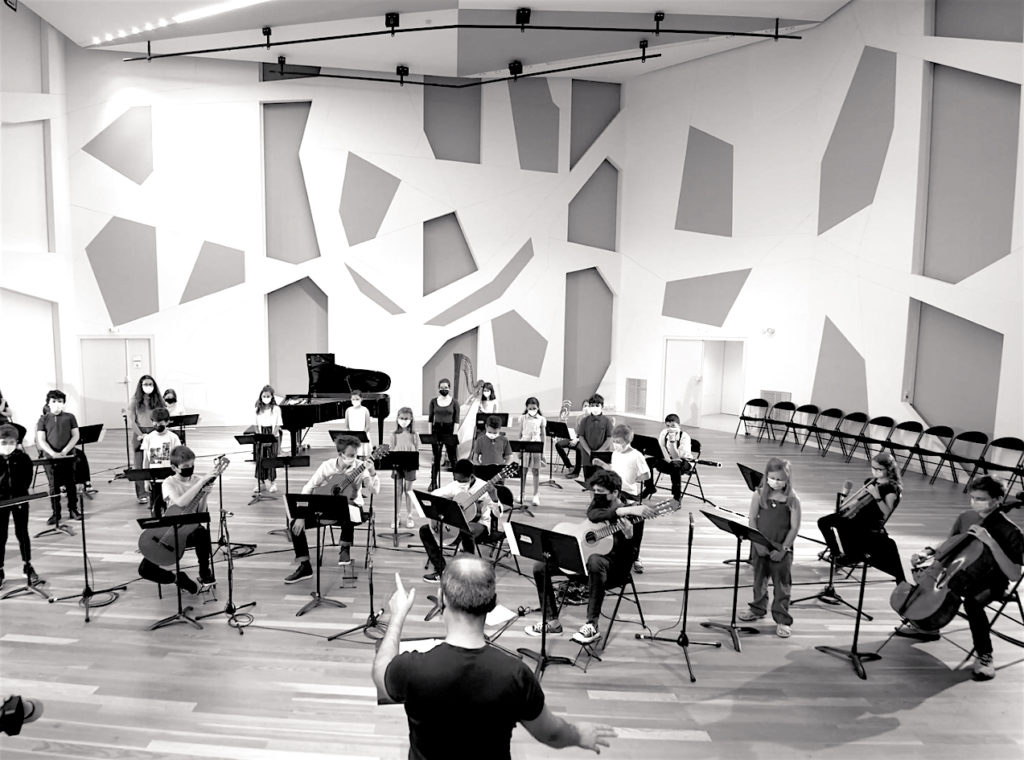
For many years, Sphota’s musicians have accommodated a diverse range of invitations, including an ensemble wanting to incorporate improvised sequences into a concert program; teaching or professional development structures aiming to bring students and teachers solid foundations in musical invention; and even structures pursuing cultural projects based on musical encounters (for example: the conception and direction of musical shows that bring together young musicians and elementary classes as both performers and spectators in a musical experience; training and directing two ensembles of ten musicians to form the chorus in professional on-stage performances of Sphota’s “Antigone Orchestra”, and so on).
Sphota’s musicians have worked with a range of organizations including the CNSM de Paris, the CRRs de Chambery, Annecy, and Nimes, the CEFEDEM Ile-de-France and Bourgogne, the CFMI de Lille, Lyon and Orsay, Pôle sup de Dijon, Pont Supérieur de Bretagne, ADIAM 78, Conservatoire Maurice Ravel in Paris, Ensemble Carpe Diem, two years in the “Chantiers de la creation” program (Orchestre National de Lyon), two years of Ateliers de la création (IRCAM), in elementary schools, middle schools, high schools, and universities across France, and the general public during residencies in traditional performance structures.
les projets
• La symphonie du quotidien, une création jouée en public avec un groupe d’une douzaine de spectateurs, autour de prises de sons et d’objets sonores de leur quotidien (2025, CCAM Nancy)
• Les écoutes participatives, un projet avec une vingtaine de spectateurs volontaires autour de l’écoute, ayant donné lieu à une installation et un podcast (2024-2025, CCAM Nancy)
• Master Class à l’Ircam autour de l’utilisation de l’improvisation dans la composition (janvier 2025)
• Création d’un spectacle avec un groupe de 20 élèves musiciens et comédiens, sur des textes de Pierre Kuentz et Alexandre Tarkos. Avec le CRR de Nancy et le CCAM de Vandœuvre-les-nancy (2023-24)
• Création d’un opéra de Samuel Sighicelli avec le Pont Supérieur de Bretagne à Rennes (2022-2023)
• Masterclass d’improvisation pour les élèves du cursus de composition à l’Ircam. (février 2022)
• Masterclass au CNSMD de Paris dans la classe de composition de Luis Naon. (décembre 2021)
• Création avec 4 groupes d’élèves (cycle 1 et 2) d’écoles de musique et conservatoires du département des Hauts-de-Seine (2021 – 25h)
• Création Hörspiele, avec 10 élèves comédiens, 3 élèves en son, et 3 professeurs musiciens du conservatoire d’Annecy (2018-2019 – 10 jours)
• Création – Intégration d’un groupe d’enfants de primaire dans le spectacle Critical phase (2018 – 3X3h)
• Création avec une classe de CM2 à l’école Pasteur à Chambéry et l’école de la Prairie à Annecy, dans le cadre de l’Orchestre à l’École
• Masterclass de composition (élèves en son, analyse, composition, électro…) novembre 2017
• Intervention au collège Côte-Rousse autour de Fragments… février 2017
• Masterclass de composition : classe de compo Chambéry (février 2017)
• Masterclass de composition : classe d’écriture et FM Chambéry – (février 2017)
• Intervention auprès d’élèves de 1ère Littéraire option musique au Lycée Les Pierres Vives de Carrières-sur-Seine. Autour du spectacle de Folk Blues Remains. (février 2017)
• Interventions au lycée Baudelaire à Annecy (janvier 2017) autour de la création de Spirale (rencontre en répétition, conférence et atelier son (2X3h))
• Discussion publique autour de l’histoire du Blues et du spectacle Folk Blues Remains avec Christian Bethune (2017) – Maison de la musique de Nanterre.
• Masterclass – musique à l’image – à destination des professeurs (8h)
• Création – Fragments pour une théorie des masses à l’usage des jeunes générations, œuvre composée pour un orchestre symphonique d’élèves de conservatoire et élèves de théâtre – montée à Chambéry et à Annecy (une quinzaine de services pour chaque conservatoire)
• Création – reprise de Marée noire avec les élèves de théâtre (cycle 2 ; 4X3h)
• Atelier : la pédagogie de l’improvisation – atelier à destination des professeurs – juillet 2016 (2X3h) Annecy
• Ateliers Musiques actuelles : 3 ateliers de 3h dont 1 avec Caravaggio au Brise Glace – avril 2016
• Création – Réappropriation de l’opéra « Der Schauspiele Direktor » de Mozart avec les élèves de plusieurs disciplines et cursus (musique, théâtre, danse) au CRR d’Annecy
• Ateliers d’improvisation générative (avec musique/théâtre, petits enfants, étudiant du cursus CEPIT…)
• Master class d’improvisation générative (2014) – Conservatoire de Nîmes
• Master class et création du projet avec les élèves du département improvisation (7 mai 2014) – CNSMD de Paris.
• Les Ateliers de la création (2012-13) – IRCAM, Lycée Lamarck Rillieux-la-Pape, GRAME et Institut d’Art Contemporain de Villeurbanne – 30 heures d’ateliers sur toute l’année avec une classe de 1ère pour l’élaboration d’un projet restitué en fin d’année au Centre Pompidou à Paris.
• Les Ateliers de la création (2011-12) – IRCAM, Lycée Lamarck Rillieux-la-Pape, GRAME et Institut d’Art Contemporain de Villeurbanne – 30 heures d’ateliers sur toute l’année avec une classe de 1ère pour l’élaboration d’un projet restitué en fin d’année au Centre Pompidou à Paris.
• Interventions dans des chorales d’enfants pour le projet Aganta Kairos (Meylan, Compiègne, Dunkerque…)
• Interventions sur la Transversalité (2012) – Université de lyon 2 (3X2h)
• Master class de composition : Villeurbanne, Lyon, Annecy, Chambéry, Nîmes, Toulouse, Meylan, Boulogne…
• Atelier musique/image (2011) – 12h – Collège La Clavellière (Oullins)
• l’Etant (2010) – oeuvre chorale pour jeunes chanteurs – Commande de l’Association AvEc – répétitions avec les élèves pendant une semaine
• Ateliers d’improvisation dirigée (2005-06) – CFMI de Lyon – pour le spectacle Antigone Orchestra de la compagnie Sphota
• Rencontres et ateliers avec des enfants sur la tournée du spectacle Silence et péripéties de la compagnie Sphota (2005)
• SLALOM (2002) – Création/Atelier – Conservatoire du Blanc-Mesnil – Réalisation d’une pièce en partie écrite en partie improvisée impliquant les professeurs du Conservatoire (une dizaine de séances)
• Présentation du métier de compositeur dans des classes de primaires, collèges, lycées (villeurbanne, Levallois, Oullins, Meylan, Paris, Annecy, Chambéry, Valence, Privas…)
• Master class d’improvisation générative (2001) – CFMI de Lille – Plusieurs ateliers en direction des étudiants dumistes
• Master class d’improvisation générative (1999) – 3 jours – Conservatoire National Supérieur de Paris – Classe d’Alain Savouret
• Les chantiers de la création (1999-2000) – Auditorium Orchestre National de Lyon – projet dans 2 classes de primaires lyonnaises, sur toute l’année scolaire, en collaboration avec des dumistes et des musiciens de l’orchestre. Restitution à l’Auditorium en fin d’année.
• Les chantiers de la création (1998-99) – Auditorium Orchestre National de Lyon – projet dans 2 classes de primaires lyonnaises, sur toute l’année scolaire, en collaboration avec des dumistes et des musiciens de l’orchestre. Restitution à l’Auditorium en fin d’année.
• Step by step (1998) – création pour l’orchestre d’harmonie amateur de la ville de Brétigny sur Orge – commande de l’ARIAM IDF – rencontres et répétitions avec les musiciens